

A recent article in the Yakima Herald-Republic avoided mentioning Save Family Farming’s specific criticism of anti-farming activist group We Are ELLA’s false claims against the Lower Yakima Valley farming community.
The article led readers to believe that our problem was simply with the fact that ELLA produced their anti-farm propaganda film, “The Price Of Plenty,” with state taxpayer dollars.
But the real problem is that the group’s claims, funded by taxpayers, are false–as was the impression ELLA gave that those false claims were endorsed by the Washington State Department of Health.
Fair reporting would’ve reflected that crucial aspect of our criticism. But instead, the newspaper’s article actually allowed the activist group to repeat some of those false claims, without even mentioning that we directly challenge their veracity.
Not only does this silence our voice of concern, but shouldn’t the newspaper itself require ELLA to substantiate their anti-farm claims?
We’ve recently reported when the Yakima Herald-Republic even required a local farmer to back up details in his recent letter to the editor, but had apparently not applied that same standard of verification to the very article the farmer was voicing concern about.
Here’s the complaint we emailed to the Herald-Republic immediately after their out-of-balance article was published:
Thank you for reporting that there are concerns about We Are ELLA’s “The Price Of Plenty” film, and for reaching out to speak with me briefly.
However, I was disappointed to see no mention or coverage of the substance of our concerns about the claims in the Price Of Plenty and other public messaging from We Are ELLA.
Those unsubstantiated and often outright false claims and suggestions include:
- Farming in the Yakima Valley is “pouring poison into the waterways, and people are left to suffer the consequences”
- Over 99% of nitrogen pollution in the Lower Yakima Valley is coming from dairy farms
- Large dairies cannot be sustainable, and generate more waste than the surrounding areas can safely absorb
- Farms are to blame for Mabton’s dirty city water
- The residents of the Lower Yakima Valley are fighting just to survive the horrendous conditions farming has created
- Farming in the Yakima Valley is causing asthma, cancer, heart disease, and diabetes
- Large dairies are the biggest polluters in the Columbia River Basin
- Dairy runoff happens regularly
- Farmworkers are being exposed against their will to “deadly pesticides” causing devastating health conditions including cancer
- It’s “a fact” that soil in the Lower Yakima Valley is no longer healthy because farmers are overusing nitrogen fertilizers
- People are pouring concentrated chemicals into wells, causing people to have cancer, and there’s science and documentation behind this
- The Lower Yakima Valley is a “dumping ground” for things other people don’t want
- Farming in the Lower Yakima Valley has directly contaminated wells, poisoned the air, and caused widespread illness and injury
- Farming is causing an environmental and health crisis in the Yakima Valley
- Farming in the Yakima Valley is responsible for the deaths of many people
- Toxic farming runoff is affecting everything in many areas of Eastern Washington
Your article’s assertion that We Are ELLA’s film and public messaging have “ruffled some feathers” because of their “focus on the negative side of the Yakima Valley’s main economic driver” isn’t accurate.
That wording belies the fact that our problem isn’t with any legitimate criticism, but with We Are ELLA’s false characterization of farming. The “negative side” you report the group “focuses on” is, in reality, an amalgamation of half-truths and outright lies, and amounts to mis- or dis-information.
The problem isn’t that this group criticizes farming, but that the group’s criticism of farming is based on false and unsupportable claims designed to harm the farming community.
Your story does not convey that aspect of our concerns.
Does farming sometimes cause smelly odors? Of course–people are welcome to complain about that, and communities have and will continue to debate how to react to that.
Are farmers taking deliberate steps to deeply harm (“poison”) their neighbors and community? Of course not–and when We Are ELLA makes such claims, particularly without any proof, it’s obviously intended to harm, misinform and attack.
I certainly hope you can understand the difference. But I’m disappointed that your coverage doesn’t reflect that important aspect of our concern. And I’m disappointed that your publication, to date, has failed to examine the false nature of many of this group’s very loud and public accusations against the farming community.
Will your newspaper look at whether We Are ELLA’s pointed claims are true? Or will their harmful attacks be allowed to continue without honest examination?
Even Maria Fernandez’s statement to you that “…[T]hey removed the [DOH] logos when asked to do so,” is easily disprovable with a simple review of their social media feed. Why was this not checked?
https://www.facebook.com/WeAreELLAOrg/videos/1366468461304593
https://www.facebook.com/WeAreELLAOrg/videos/550159338188121Further, will those of us to stand up to question the accuracy of We Are ELLA’s claims be painted as simply having a difference of opinion, while demonstrably false statements and accusations are allowed to continue unchecked?
After we emailed that complaint to the reporter and his managing editor, we were glad to see a correction and an editor’s note added to the story that exposed We Are ELLA Executive Director Maria Fernandez’s claim that they had removed the DOH logo from their videos as false.
- Original false claim: “Fernandez said that they removed the logos when asked to do so, following Save Family Farming’s complaints.”
- Added sentence: “The DOH logo is still visible on some ELLA social media videos.”
- Added note: “Editor’s note: This story was updated to include information about the DOH logo on ELLA social media videos.”
This was basic fact-checking that the Yakima Herald should have done on Fernandez’s claim from the outset, without us having to complain.
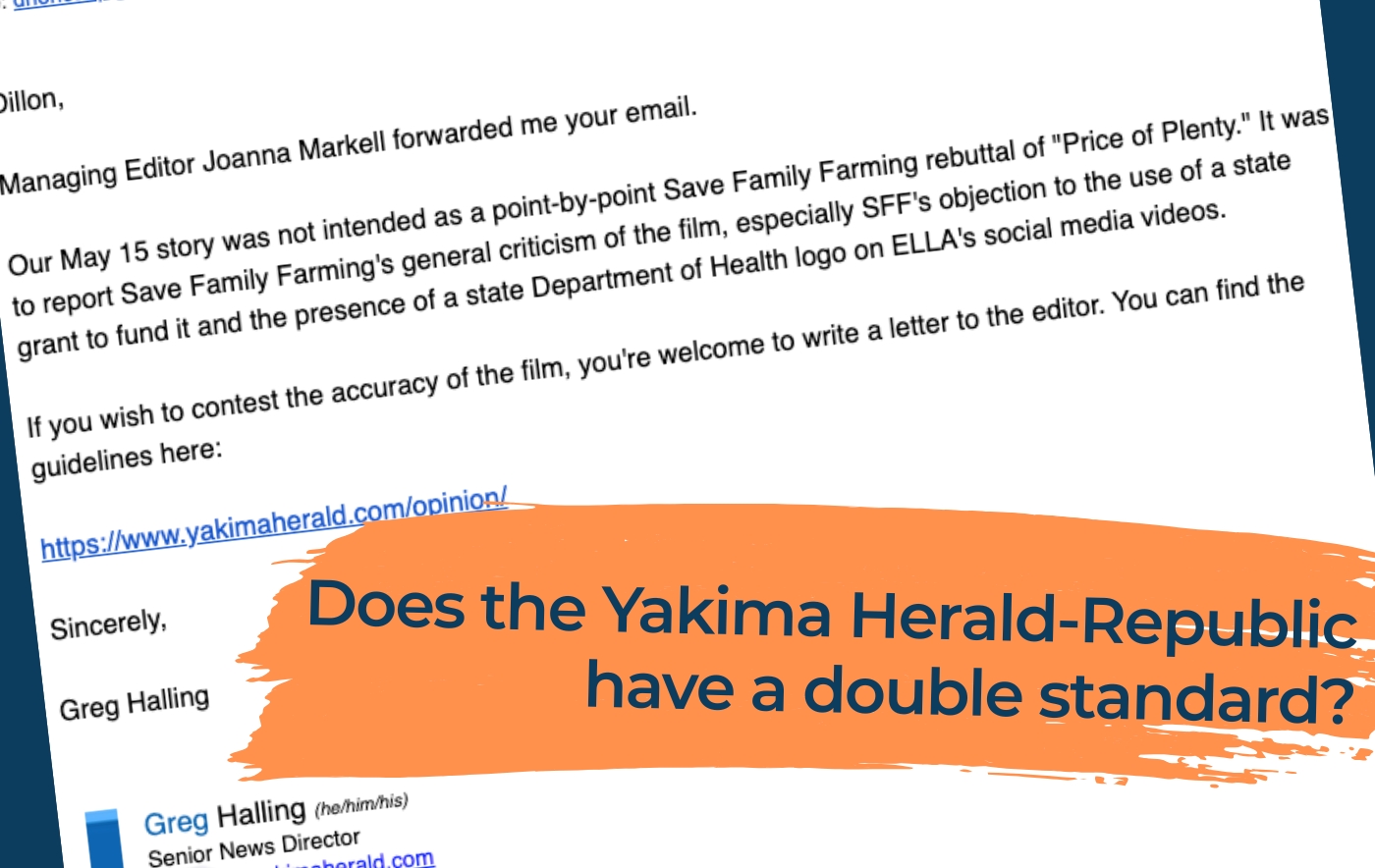
Despite this tacit acknowledgement of at least one of the problematic aspects of the article, we were very disappointed with Yakima Herald-Republic Senior News Director Greg Halling’s eventual disingenuous response to our initial complaint:
“Our May 15 story was not intended as a point-by-point Save Family Farming rebuttal of “Price of Plenty.” It was to report Save Family Farming’s general criticism of the film, especially SFF’s objection to the use of a state grant to fund it and the presence of a state Department of Health logo on ELLA’s social media videos.
“If you wish to contest the accuracy of the film, you’re welcome to write a letter to the editor. You can find the guidelines here: https://www.yakimaherald.com/opinion/
“Sincerely, Greg Halling”
We’re very disappointed that Halling and the Yakima Herald-Republic was unwilling to respond to our specific questions and concerns about their article, particularly considering that we’ve clearly never asked for or expected a “point-by-point Save Family Farming rebuttal of ‘Price of Plenty,'” as he disingenuously suggested.
We’re simply asking for fair coverage. We’re simply asking that the anti-farming claims the Yakima Herald-Republic reports from politically-charged activist groups’ receive the same level of scrutiny as farmers’ opinions–such as when the newspaper recently required extensive fact-checking and “substantiation” on a simple letter to the editor from a local farmer.
The paper’s non-response to our specific concerns about this inconsistency suggests the problem isn’t a result of honest reporting lapses, but may actually be a willful effort to bias its coverage against the farming community.
You can’t play hardball with local farmers, and throw soft with anti-farm propagandists We Are ELLA at the same time.
The appearance of a double standard in Yakima Herald-Republic’s coverage of farming is glaring, and sadly is nothing new.
We’ve attempted to resolve these issues privately, but now that the Herald-Republic’s leadership expressed its unwillingness to address–or even acknowledge–the substance of our legitimate concerns about bias in their reporting, we are sharing this all publicly.
The Yakima Herald-Republic’s readers should know that they’re not getting fair and balanced coverage–at least not when it comes to reporting on the farming community.