

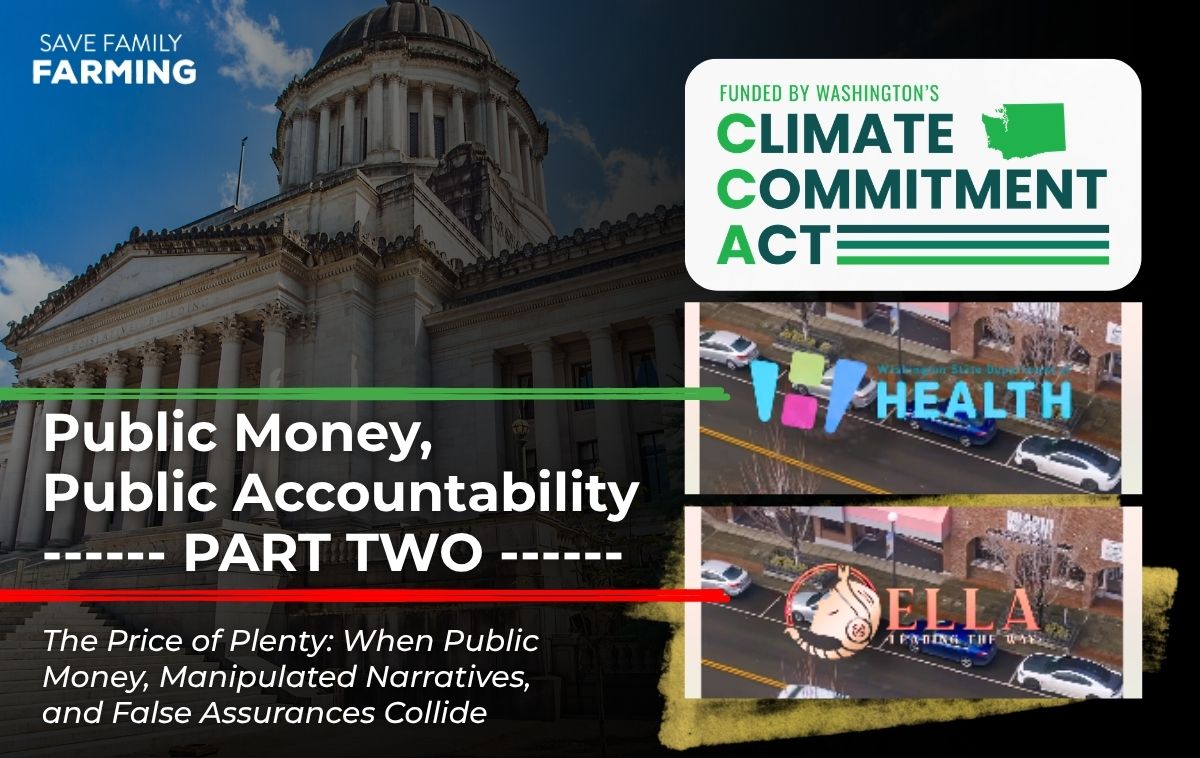
The Price of Plenty: When Public Money, Manipulated Narratives, and False Assurances Collide
By Ben Tindall, Executive Director, Save Family Farming
In Part One of this series, I explained how a complaint about the unauthorized use of the Washington State Department of Health (DOH) logo opened the door to much larger questions about a $499,200 state grant awarded to Empowering Latina Leadership and Action, better known as ELLA. What began as a straightforward branding complaint eventually exposed failures in DOH’s oversight and raised serious questions about what Washington taxpayers actually helped fund.
We’ll explore the actions, or inactions, of DOH further in our next part but accountability does not stop with the agency. ELLA’s own conduct deserves a great deal of scrutiny.
Save Family Farming now has statements from various DOH representatives showing ELLA to be an organization that inappropriately used a state agency’s identity without any authorization, directly lied to that agency by stating the problem had been corrected when it had not, missed a second corrective deadline, and ultimately left the offending videos online while posting carefully negotiated language that never plainly acknowledged what it had done, tacitly suggesting it was somehow their audience’s fault for being confused.
At the same time, DOH acknowledges that ELLA was using taxpayer-supported media resources to build an advocacy operation that eventually fed into The Price of Plenty: Voices of the Yakima Valley, a propaganda film that repeatedly uses selective facts, emotional imagery, and unsupported implications to make false accusations against agriculture.
Taken together, these are no longer isolated communications mistakes. They raise fundamental questions about ELLA’s credibility, transparency and willingness to accept accountability when its own actions are challenged.
Who is ELLA?
ELLA was founded by Maria Fernandez who also serves as the organization’s Executive Director. ELLA presents itself as a community organization working to “to increase Chicana/Latina representation.” Its own website says it organizes around issues, canvasses communities, trains Latina leaders for public office, teaches grassroots organizing, and prepares participants for service on city councils, school boards and commissions.
This matters when ELLA portrays itself simply as a credible conduit for receiving substantial public funding. This is an organization with an unmistakable advocacy agenda and an explicit interest in shaping public policy, elections and political leadership.
And its record on transparency and following the rules is not spotless.
As ELLA expanded from community advocacy into the electoral arena, Fernandez created ELLA Adelante, a separate 501(c)(4) organization that she is also listed as the Executive Director of. By 2023, ELLA was training prospective candidates for public office, while ELLA Adelante developed into an organization that endorses candidates, mobilizes voters and explicitly seeks “to build political power.”
During the 2024 election cycle, ELLA Adelante distributed thousands of candidate-related door hangers and published posts opposing a statewide ballot measure without required sponsor identification. Its attorneys acknowledged the mistake, and the Washington Public Disclosure Commission ultimately issued the organization a formal written warning.
During the 2025 general election season, ELLA and ELLA Adelante promoted a Sunnyside voter-engagement event reportedly involving ballot printing, ballot submission and voter registration that also offered a raffle featuring a television and other prizes. The event prompted complaints that prizes connected to ballot activity could cross Washington’s prohibition against offering a reward or thing of value in exchange for a vote.
The matter was addressed to the Yakima County Prosecutor’s Office which chose not to file criminal charges but sent ELLA a warning letter stating that their actions were “a potential crime, and reminding them of certain election laws and that violation of those laws was a crime.” According to The Center Square, “We Are Ella…declined to respond to emails” for comment.
Additionally, an unresolved transparency issue involving Vicky Frausto, Sunnyside’s mayor and Director of Operations for ELLA and ELLA Adelante, is the subject of an open Washington Public Disclosure Commission case involving her annual personal financial-affairs disclosure. According to the complaint and reporting, her original filing omitted more than $100,000 in compensation associated with ELLA and ELLA Adelante. Frausto subsequently amended her disclosure and has characterized the omission as an “honest mistake.”
Apply these examples to the year-long attempts to get this organization to comply with the state’s requests around the use of state property, and a pattern seems to be emerging. What makes all of this particularly striking is how often ELLA uses the language of accountability, transparency and integrity when talking about everyone else.
Now we come to the Department of Health controversy.
At this point, we’re not going to dance around what happened with the DOH logo.
ELLA published videos containing the official Washington State Department of Health logo. DOH confirmed in April of 2026, that it did not authorize ELLA to use the logo and that the Department does not endorse the specific claims made in those videos. According to Erika Baker, DOH Deputy Director of the Office of Environmental Public Health Sciences, DOH “did not receive or approve a request to use the agency logo prior to the content being posted on social media. Upon notification of its use, we immediately contacted ELLA to have the logo removed.”
That was the request, both Save Family Farming’s, and more so DOH, to have the logo removed from these videos. It’s not a difficult task. They went to the trouble to put videos together, to edit them specifically, and post them online. This organization obviously knows how to edit short videos.
In the initial response from Baker, she said, “We have worked diligently with ELLA, and they have been responsive in removing our logo from their digital content.” There was a problem though–the logo wasn’t removed.
It took a matter of seconds to check ELLA’s own Facebook account and see that the videos remained intact online with the DOH logo unchanged. So what happened? Save Family Farming followed up and challenged DOH’s claim that this was resolved. Erika Baker eventually responded again and explained that her “previous statement that the logo had been removed was based on confirmation from the grantee that the concerns raised to our attention had been corrected.” DOH then acknowledged that video uploads remained intact with the unauthorized logo and admitted that its follow-up had been insufficient.
Woah, that is not a case of ELLA saying, “We will take care of it,” and then forgetting. This is apparently someone within that organization giving “confirmation” to a state agency that is responsible for their receipt of nearly half a million dollars in taxpayer funded grant money “that the concerns raised to [DOH’s] attention had been corrected.” The requested correction, according to Baker, was removal of the DOH logo. ELLA’s Executive Director, Maria Fernandez, told the Yakima Herald-Republic directly that her organization “removed the logos when asked to do so, following Save Family Farming’s complaints.” The news article calls this statement out by acknowledging that “The DOH logo is still visible.”
DOH and the media exposed that ELLA’s confirmation was false. When an organization tells a state agency, as well as the general public, something that is blatantly not true, that’s called a lie. ELLA appears to have lied to the Department of Health as well as to the media, and its own social-media account seems to catch them in the lie.
Then ELLA blew through another deadline
DOH could have treated ELLA’s apparent lie as a serious compliance issue. Instead, the Department decided to return to ELLA and negotiate another solution. On August 25, Save Family Farming Executive Director Ben Tindall met with DOH Assistant Secretary Lauren Jenks to discuss this situation and determine next steps. Save Family Farming had already communicated with the State Auditor’s office, Legislators, and an attorney regarding this situation. At the conclusion of this first meeting, Jenks explained that her office would continue to work with ELLA to either remove the videos from their social media or edit the videos to remove the DOH logo. Jenks requested a follow up meeting in two weeks with the hope that an update would be provided.
The day of the scheduled meeting, Save Family Farming received a message from Jenks’ assistant asking to reschedule and stating that “the posts are not updated in the timeframe we agreed to, and we are continuing to follow up.” The message then explains that DOH and ELLA jointly developed public language explaining their relationship. Maria Fernandez reportedly agreed to place a longer statement on the organization’s main feed and shorter language beneath the affected videos. Jenks’ assistant clarified that “Maria [Fernandez] agreed to post a statement crafted in collaboration with DOH to clarify the nature of our funding relationship. This statement was to be posted to both the main feed and video posts by the end of last week.” Which it was not.
The wording itself is quite remarkable in what it says, as well as in what it does not say.
Rather than admitting that ELLA used the DOH logo without authorization, the statement says “the inclusion of the DOH logo created some unintended confusion.” Rather than acknowledging that ELLA had previously deceived DOH by stating that the problem had been corrected when it had not, the statement emphasizes collaboration, partnership and transparency. There is no admittance of wrong or an apology for their actions. Instead, the statement gaslights those who were complaining about the organization’s actions as though they are the ones who are confused.
Viewers did not invent the association between ELLA’s message and DOH. There isn’t any confusion about the fact that ELLA put DOH’s identity on its videos without authorization. There isn’t any confusion around the fact that, when DOH challenged that action, ELLA gave the agency a confirmation that proved to be a lie. There isn’t any confusion around the fact that, when ELLA agreed to develop and post a statement on their social media feed, they failed to do even that by the agreed deadline.
Eventually, the shorter statement appeared in the comments underneath at least two of their videos. Yet the original videos remained online and the DOH logos continued to be displayed. The longer statement has yet to be placed on ELLA’s main feed as apparently agreed upon. Again, simple expectations and requests trampled on and ignored by a defiant activist group which apparently has every reason to believe it will get away with it.
Apparently, deleting a Facebook video was too much to ask
When the follow up meeting with Assistant Secretary Lauren Jenks finally happened, she explained that DOH had ultimately accepted the statement language because ELLA supposedly could not alter the certain videos that used the DOH logo. When I asked why ELLA could not simply remove those posts or edit the videos, Jenks admitted that she did not know.
That explanation strains credibility. ELLA is sophisticated enough to produce videos, manage social-media campaigns, organize political advocacy, and produce a feature-length documentary. Yet somehow removing a Facebook video containing an unauthorized state logo became technically insurmountable?
Any teenager with a social-media account knows how to delete a post.
Then look at what taxpayers helped fund
The logo controversy becomes far more serious once The Price of Plenty enters the picture.
When we initially asked DOH whether it had sponsored, contributed to or otherwise supported production of ELLA’s videos, Erika Baker responded that although part of the grant funded “community storytelling through media,” DOH did not provide editorial oversight and did not “sponsor or contribute to the specific content or production of the videos.”
In light of the messages and statements that have been reported since then, it appears that this was a very carefully crafted response meant to distance DOH funding from the production of the video content being used for this anti-farming propaganda film.
ELLA’s signed Statement of Work explicitly required the organization to “create a short film documenting community involvement in environmental justice.” The deliverable was reels, short videos, podcasts and radio programming culminating in a short film to be shared with communities, public officials and state agencies.
The budget included $25,000 specifically for a videographer to create the short film, another $20,000 for a marketing consultant, another $20,000 for advertising and promotion, and $162,000 for staff implementing the grant activities and deliverables.
In Baker’s initial response, she acknowledged that DOH knew grant-funded materials would be used to create a documentary. And when DOH later helped ELLA draft its corrective statement, the Department agreed to language saying that DOH grant funding “made it possible” to document and elevate the stories and very directly stated that “DOH provided funding for this project.”
In the Yakima Herald-Republic article, Maria Fernandez directly admits that a portion of the taxpayer funded grant “went toward the filming of the documentary.”
No one is claiming DOH sat beside an editor and chose every frame of The Price of Plenty. But the misleading minimization of the state’s contribution to production becomes extraordinarily difficult to defend when its own contract budgeted money for a videographer to make a film and its own later wording acknowledges that DOH money helped fund this project. So, since both ELLA and DOH acknowledge that Washington taxpayers helped fund this film, let’s look at The Price of Plenty.
What did that taxpayer-supported media operation produce?
The Price of Plenty is presented as a collection of voices from the Lower Yakima Valley. Watch it closely, however, and the viewer can quickly see that this is not simply residents telling their stories. It is a carefully constructed propaganda film that uses selective editing, emotionally loaded images, unsupported causal implications, and missing context to steer viewers toward one conclusion: agriculture, particularly larger farms and dairies, are responsible for a sweeping range of environmental, health and social problems in the valley.
Before viewers have been given much information at all, they are shown dirty-looking irrigation water, manure, dairy facilities, dust and other farm imagery while listening to claims involving contaminated drinking water, pesticides, asthma, illness and environmental damage. The editing does the work. Put an image of a dairy next to a person talking about sickness, and the viewer is encouraged to connect the two whether the film has actually established that connection or not. That technique is repeatedly used throughout the production that tax payers helped pay for.
Start with the water
Within seconds of the film beginning, viewers see dirty-looking water spraying from agricultural irrigation equipment. That kind of imagery appears repeatedly in the film and the visual message is obvious: look at what agriculture is doing to the water.
Except that dirty-looking water is actually simply cow manure–organic fertilizer–being applied to crops and is not at all the water coming out of a kitchen faucet. Yet, the film repeatedly places those images alongside discussions of drinking-water contamination, creating an association to the image that is not substantiated and no one in the film differentiates between the two very different things. Manure is not household drinking water and what’s coming out of the irrigation system is not meant to be drunk.
Later, a resident discussing dairy waste says, “I’m sure all of that gets into the dirt and then gets into the water.” That blatantly ignorant take really demonstrates how much of the film’s case is built. While that may be this person’s belief, claiming “I’m sure” is not tracing a source. It is not a scientific finding identifying what entered a particular well, where it originated or when it arrived. It is a person’s subjective conclusion, and the film consistently uses surrounding imagery and creative editing to give that conclusion the visual weight of established fact. It also ignores the reality of dairy nutrient management plans and a long list of regulations that specifically prohibit this kind of outcome.
The same problem appears when a resident describes her water as smelling like rotten eggs or sulfur. There are a plethora of reasons for why hydrogen sulfide odors can occur naturally through soil and rock chemistry, can be caused by sulfur bacteria in wells or plumbing, and can even originate inside a water heater. Yet that context or nuance is not shared in the film while the filmmakers appear to be laying the blame at the feet of agriculture.
The pesticide story follows the same formula
The film relates the story of Ventura, a worker who alleged he suffered pesticide exposure after entering an area marked with a 72-hour warning. Yet the film never establishes the basic facts necessary to prove what actually happened. Ventura apparently did not immediately seek medical care. Instead, he says a friend (whose medical training or expertise is never established) looked at photos on a phone and helped him conclude what his condition was. Months later, Ventura sought medical care, but the film does not present a medical determination establishing that his condition was caused by pesticide exposure.
Another anonymous interviewee acknowledges that the farm where he worked provided pesticide training but says, in his opinion, that the training was insufficient. Washington’s Worker Protection Standard requires training, application information, restricted-entry protections, protective equipment and other safeguards. If ELLA wants to demonstrate that an employer violated those requirements, it should present evidence of the violation. Instead, the film repeatedly asks viewers to accept allegations as proof and then uses those anecdotes to condemn a broader system.
The film turns assertions into evidence
The film records assertions that farmers are making large amounts of money from practices they do not want to change, that pesticides have cost numerous lives, that agriculture continues to “pour poison into our waterways,” and that government subsidies are what sustain dairies. These are sweeping claims, yet the film does not stop in those sequences to show the viewer the underlying financial records, mortality data, or any other actual evidence to back these up.
Of course a filmmaker is entitled to interview someone who believes an industry is harmful. But an interview subject’s accusation does not become an established fact merely because dramatic footage plays underneath it.
One worker says employees have to break rules or risk losing their jobs. Another recounts alleged illegal dumping and suggests retaliation followed. Those allegations could be serious if substantiated. But the film does nothing to provide viewers with an incident report, enforcement record, employer response or other corroborating documentation within those sequences.
Basically, the accusation is presented. The agricultural employer becomes the implied villain. Then the film moves on. This is not a neutral documentary, but a manipulative attempt at persuasion.
The Randy Vasquez tragedy exposes the film’s selective storytelling
One of the clearest examples of this comes when Jean Mendoza, Executive Director of Friends of Toppenish Creek, recounts the tragic 2015 death of dairy worker Randy Vasquez. Mendoza criticizes information released about Vasquez’s death as being “very selective.” Yet her own retelling is highly selective, too. Investigations after the incident reveal a more complicated situation with numerous factors in play. The film also leaves out facts that complicate the story Mendoza is telling.
Mendoza focuses on the roughly $2,000 workplace-safety penalty and says she was “appalled by the lack of concern by our agencies for this man’s life,” adding, “I think a man’s life is worth a lot more than $2,000.”
Of course a man’s life is worth more than $2,000. But that was never what the fine represented. As the Yakima Herald-Republic reported, the amount of such a penalty is calculated using factors including employee exposure and the employer’s safety history; state labor officials said the penalty would have been the same even if no one had died.
The irony of Mendoza complaining about “selective” information while selecting only the facts that serve the film’s preferred narrative is exactly the problem with The Price of Plenty: complicated events are repeatedly reduced to emotionally powerful accusations, while facts that interfere with the film’s effort to cast farms as the villain are left outside the frame.
Air pollution becomes another exercise in selective blame
The same selective messaging mixed with manipulative editing technique is used with air quality. The film repeatedly places agricultural dust, dairies and other farm imagery alongside people discussing respiratory problems. What viewers largely do not receive is the complexity of Lower Yakima Valley air quality.
Research in the region identifies multiple particulate sources, including residential wood smoke, wildfire smoke, vehicle emissions, backyard and agricultural burning and other emissions. The valley’s geography and periods of stagnant air also affect how pollution accumulates. The Yakima Regional Clean Air Agency reports multiple direct sources of PM2.5 and explains the role of atmospheric conditions in trapping pollution. The film spends a matter of seconds acknowledging the reality of wildfires and smoke, and quickly refocuses the blame on agriculture.
The film cherry-picks the numbers and stories with no context or details
At one point, the film presents farmworker-income information in the middle of a story about conditions in the Lower Yakima Valley. The film cites a PBS SoCal article which states that “Farm work remains one of the lowest-paid and most dangerous jobs, with the average annual farmworker salary for a family at $20-24,000 a year. 33% of farmworkers live below the poverty level.” Again, there is no context of dates or details regarding this blanket citation in ELLA’s film.
The reality is that the PBS SoCal article pulls these numbers from a 2018 report titled, “Findings from the National Agricultural Workers Survey (NAWS) 2015-2016“ which surveyed farmworkers about their work during 2014-2015 (10 years before The Price of Plenty was produced). The survey respondents reportedly “performed an average of 192 days of farm work…and workers reported earning an average of $10.60 per hour.” Yet, in 2025, Washington’s minimum wage was $16.66 and the wage rate for farmworkers in Washington is generally significantly higher. The Washington Policy Center reported that “According to the most recent data available in 2023, the average wage rate for farmworkers in Washington state was $19.02/hr. That same year, Washington state’s statewide minimum wage was set at $15.74/hr.” The data was already 10 years old, the wages and reality it’s describing is not relevant to farmworkers in Washington state.
That is exactly why context, integrity, and transparency matters, but ELLA doesn’t seem to be concerned about that in this film, as the pattern continues.
Agricultural imagery is paired with asthma claims, even though multiple sources contribute to air-quality conditions. Accounts of individual employers are allowed to stand in for broad conclusions about farms generally. Personal stories about past pesticide exposure are placed alongside modern agriculture without consistently explaining how regulations, products or practices may have changed over decades.
Maria Fernandez is frequently featured in the film and, at one point, shares a very personal story of her father’s exposure to pesticides. The story is heartbreaking, as her father contracted cancer and passed away in 1999. Maria claims that she believes her father’s exposure to pesticides is what led to his death. Again, as far as the film presents, this is conjecture with no evidence to support the claim. There is also no explicit mention of when this all took place. In a separate article, Maria wrote that this exposure happened in “the early ‘80s.” That was deeply tragic, but also it was a generation removed from modern pesticide application rules and standards. But again, there is no context presented to inform the viewer about what they’re hearing.
For the most part, dates and timeframes are conveniently absent from these stories, and the viewer is left to fill in the gaps with assumptions built on manipulated implications. Again, ELLA is entitled to make an argument. But remember: taxpayers helped finance the film making that argument.
The standard changes depending on which farmer the film likes
One of the film’s more revealing contradictions arrives later in the film after viewers have been taught to react negatively to manure, animal waste and nitrogen associated with dairy operations. These materials are repeatedly framed incorrectly as symbols of contamination and excess.
Then, about halfway through, the film features comments from Tara Villalba of Tierra y Libertad, an allegedly farmworker-owned cooperative farm. Tara discusses compost, manure and other animal material being used to enrich soil and help plants grow. Suddenly, nutrient recycling is portrayed positively.
So, what changed?
The basic agronomic principle did not suddenly become different because the farm was smaller. What changed was the protagonist.
When the film wants the audience to distrust large dairies, manure is ominous and the visual of fertilizing crops with organic nutrients is demonized. Yet, when ELLA wants viewers to embrace a preferred agricultural model, organic material and nutrients are part of building healthy soil.
That contradiction reveals just how much of this documentary is driven not by a consistent standard, but by a predetermined narrative about which farms viewers are supposed to trust and which ones they are supposed to condemn–blatant confirmation bias and propaganda.
By the end, the mask is off and The Price of Plenty openly becomes political advocacy
The final portion of The Price of Plenty makes the purpose increasingly explicit. The final third of the film moves heavily into environmental-justice messaging, praising the HEAL Act, organizing, advocacy and calls to move people from awareness toward action.
There is nothing inherently unlawful about an organization advocating for its beliefs. But this matters enormously when considering how the film was produced and how taxpayers were told their money was being used.
ELLA’s DOH grant expressly funded advocacy activities, communications campaigns, contact with community leaders and public officials, reels and videos, a videographer, marketing, advertising and a short film. So The Price of Plenty should not be viewed as some independent documentary that just happened to emerge after an unrelated government grant. Public money helped build the storytelling and media operation from which this production grew.
And what emerged was not a balanced examination of agriculture in the Lower Yakima Valley. It was a case against agriculture, followed by a political call to action.
There were virtually no competing explanations for health conditions or agricultural voices challenging the accusations being made. Instead, the film repeatedly selects the accusation, selects the image, selects the anecdote and moves on before inconvenient context can disrupt the story.
That is why Save Family Farming objects so strongly to the way taxpayer resources became entangled with this production. ELLA was free to make an advocacy film. It was free to criticize farmers. It was free to promote its environmental-justice agenda. But not on the state’s dime. If nothing else, taxpayers should be entitled to an honest accounting of the advocacy project and media production that ELLA and DOH admit they helped fund!
ELLA asks for trust while repeatedly giving the public reasons to question it
ELLA asks viewers of The Price of Plenty to trust its selection of facts, its portrayal of farmworkers and farm operations, its characterization of environmental contamination and the causal connections it invites viewers to make. It asks the state government to trust it with nearly half a million taxpayer dollars in taxpayer funds. It asks DOH to trust its representations about compliance concerns.
Trust requires credibility.
In a relatively short period, the public record now includes a formal PDC warning involving ELLA Adelante’s political advertising; an unresolved income disclosure case involving a senior ELLA leader and elected official; unauthorized use of a state agency’s logo; a confirmation to DOH that a problem had been corrected when it had not; a later missed corrective deadline; and a public claim from ELLA’s executive director that logos had been removed while at least some remained plainly visible.
How carefully does ELLA apply to itself the standards of truth, transparency and accountability that it so aggressively demands from everyone else?
Advocacy is a free-speech right. But taxpayer money comes with responsibilities.
ELLA can criticize agriculture. It can organize activists. It can advocate for more regulation, produce documentaries, contact public officials and argue that Washington farming practices need to change. Save Family Farming will vigorously challenge claims we believe are unfair, unsupported or misleading.
But the central issue here is not whether ELLA should be allowed to speak. It is whether organizations receiving hundreds of thousands of dollars in public money should be held to meaningful standards of truthfulness, transparency and compliance.
Taxpayers helped finance ELLA’s staff, storytelling, videography, marketing, promotion and short-film production. The organization then used that media infrastructure to advance a deeply one-sided case against agriculture. When questions arose about its unauthorized use of the Department of Health’s identity, ELLA gave the state an assurance that was false and in the end did little to effect meaningful change..
ELLA has become far too comfortable treating accountability as something negotiable. Again and again, serious questions about compliance have been met with little more than what amounts to a gentle slap on the wrist.
Oops, ELLA Adelante failed to include required sponsor identification on their political campaign activities. The Public Disclosure Commission issued a formal warning. Slap on the wrist.
Oops, ELLA and ELLA Adelante promoted a community event that included valuable raffle prizes in exchange for voter engagement. The Yakima County Prosecutor declined to file charges but sent a warning letter describing the actions as a “potential crime.” Another slap on the wrist.
Oops, ELLA lied to the DOH that the unauthorized DOH logo had been removed. They had not. The videos remained online with the logo intact. DOH simply went back and asked ELLA to correct the problem again. Another slap on the wrist.
Oops, Sunnyside Mayor and ELLA employee Vicky Frausto, failed to correctly report more than $100,000 in employment income. Should we just assume another slap on the wrist is coming?
Oops, ELLA disregards additional requests from DOH to remove their logo from the videos. DOH ultimately accepted a carefully negotiated statement that can be buried beneath the existing content…while the unauthorized logos remained visible. Another slap on the wrist.
At some point, a pattern becomes difficult to ignore. In Save Family Farming’s view, ELLA has repeatedly pushed against rules, disclosure requirements and corrective demands while facing remarkably little consequence when problems are identified. An organization that so frequently demands accountability from farmers, employers, public officials and institutions should not be permitted to treat accountability for itself as optional.
And that brings this series to its final question: if a grantee can behave this way after being awarded nearly half a million dollars in state funding, what responsibility does the agency that funded and supervised the grant have to respond? Why the Washington State Department of Health repeatedly accepted incomplete corrective action, what enforcement tools were available to the agency, and whether an independent review of the nearly $500,000 grant is warranted.
That is the focus of Part Three.