

For the past several years, Washington’s family farmers and farmworker have warned that rigid overtime mandates on agriculture would do more harm than good—not only to farm employers, but to the very workers these policies were supposed to protect. Those warnings were dismissed. Concerns raised by real farmers and real farmworkers were overshadowed by political pressure and lobbying from well-funded advocacy groups far removed from the realities of life in the fields.
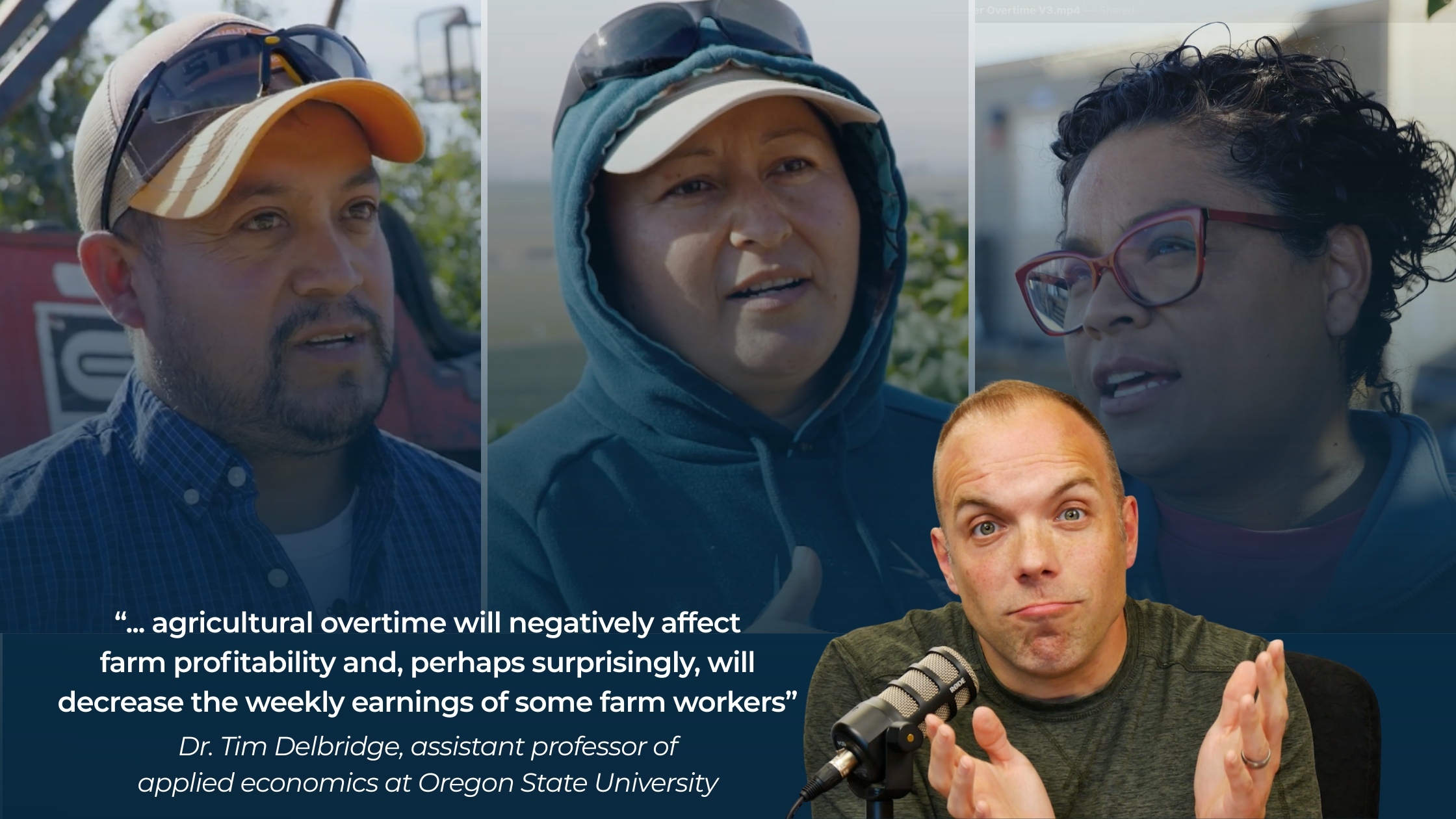
Now, the data is beginning to prove what farm owners and farmworkers across our state have been saying all along. In a recent interview, Dr. Tim Delbridge, assistant professor of applied economics at Oregon State University, outlined his research on this issue in a blog post stating, “that agricultural overtime will negatively affect farm profitability and, perhaps surprisingly, will decrease the weekly earnings of some farm workers” This is what Oregon has seen over the past several years and Washington is right behind them.
Delbridge, who co-authored the OSU study of Oregon farms, explained to Save Family Farming’s Dillon Honcoop on The Farming Show that in regards to the paychecks of farmworkers, “we can say objectively that they earned less money, after the overtime bill was passed.” Delbridge also shared that “when you’re looking at this policy and you’re thinking about the outcomes for farmers and for farm workers, it is clearly worse for farms and…it’s worse for some farm workers.”
This isn’t just a confirmation of our fears—it’s a painful vindication. The policies passed under the banner of “fairness” and “worker rights” have backfired, limiting hours, cutting pay, and forcing farmers into increasingly impossible financial decisions. Many are now asking what advocates of the overtime law failed to consider from the beginning: what happens when farm work—a seasonal, weather-dependent, labor-intensive industry—is forced into a 9-to-5 box?
Real Stories, Real Consequences
It’s not just data on a page. In Washington, the negative impacts are already being felt. In 2023, Save Family Farming helped hundreds of farmworkers gather to protest the overtime law, sharing firsthand accounts that they were working fewer hours and earning less income since the law took effect.
Migrant farmworkers are also increasingly looking to other states where they can get the hours they need. In today’s competitive labor market, word travels fast. When Washington limits hours due to unaffordable overtime thresholds, workers are going to be opting to take jobs in states that don’t cap their earnings potential. The result: a shrinking labor pool, higher risk for crops going unharvested, and farms pushed closer to the brink.
Washington is now among the most expensive states in the nation for farm labor. According to USDA data, Washington farms saw a 47% jump in labor costs from 2022 to 2023, one of the highest increases in the nation. Labor now accounts for over 32% of production costs, significantly higher than the national average. A recent analysis by the Washington Policy Center further showed that from 2017 to 2022, labor costs on Washington farms rose 32%, nearly double the rate of inflation.
Farmers aren’t just dealing with higher wages—they’re grappling with a system that forces them to cut hours, reduce crews, and stretch fewer workers over more acres. Meanwhile, their costs soar and margins vanish.
It’s Time for Real Solutions—Not Political Posturing
If our leaders are serious about finding lasting, fair solutions, then it’s time to change how decisions are made. That starts with who is at the table.
We need actual farmers—not paid lobbyists representing interests far off the farm—and actual farmworkers—not professional activists with a political agenda. These are the people who understand the complexity, seasonality, and razor-thin margins of agriculture. These are the voices that have been ignored for too long, and the consequences are unfolding in real time.
The current reality is just another nail in the coffin called “Washington Agriculture.” Fewer workers. Higher costs. Less food security. Washington agriculture cannot afford to continue down this path.
We told you this would happen. Now the research confirms it.
It’s time to fix this—before it’s too late.