

A Year of Questions, Delays, Broken Assurances, and Double Speak
By Ben Tindall, Executive Director, Save Family Farming
It all started with a logo.
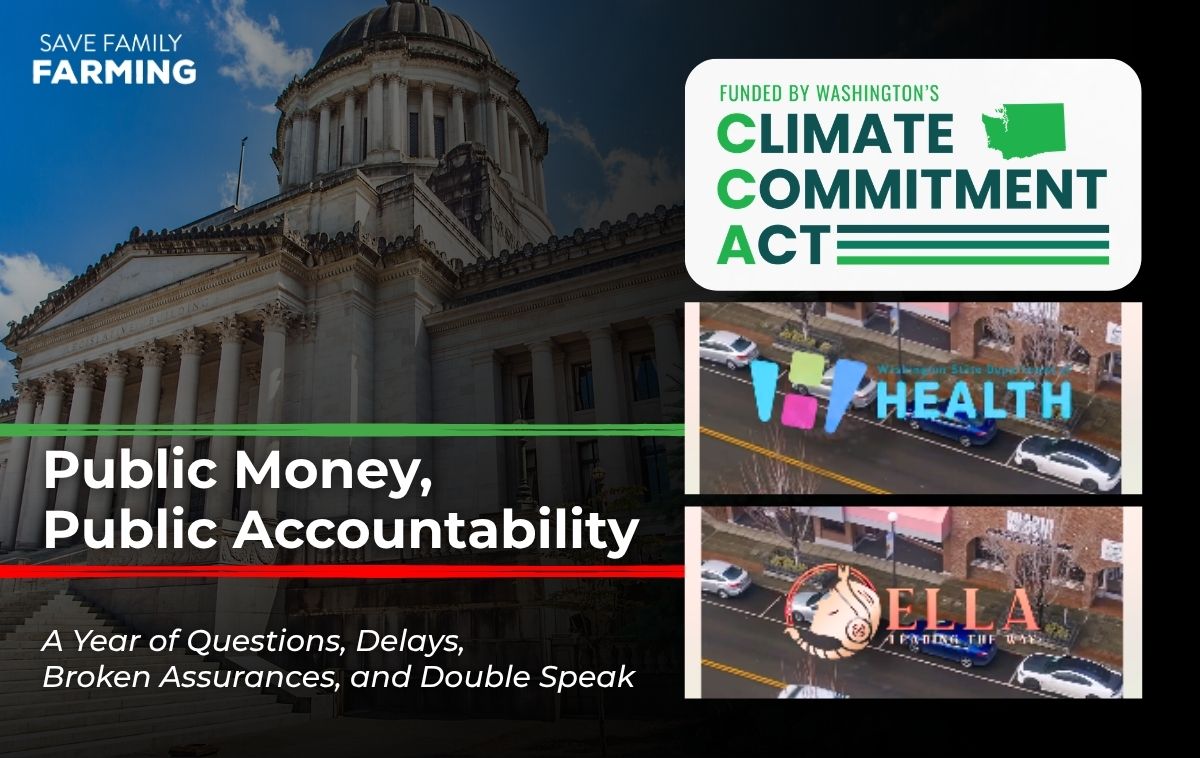
Last year, Save Family Farming discovered the official Washington State Department of Health (DOH) logo appearing at the end of several videos published by Empowering Latina Leadership and Action, better known as ELLA.
We knew who ELLA was, we had been tracking their anti-farming materials, and already knew that the organization had received a large taxpayer funded grant from the Department of Health. In 2024, DOH awarded ELLA a $499,200 HEAL Community Capacity Grant funded through Climate Commitment Act dollars.
In August of 2025, several videos on ELLA’s Facebook page caught our attention as the official DOH logo was appearing on them.
These were not neutral or educational posts. One video, posted June 6, 2025, centered on the perspective of Teodora Martinez, then a candidate for a Port of Sunnyside commissioner seat. Martinez claimed that her home’s well water was contaminated and, without citing any evidence in the video, directly accused local dairies of causing the contamination. Another video, posted February 28, 2025, highlighted ELLA’s Lobby Day at the state Capitol. It too displayed the DOH logo, raising additional questions about the use of publicly funded resources in connection with lobbying activities. At the time, RCW 42.17A.635 generally prohibited public funds from being used “directly or indirectly for lobbying.” Whatever one’s views of ELLA’s advocacy, placing the official Department of Health logo on this content created an obvious question: Was the State of Washington endorsing or helping fund these messages and activities?
So, Save Family Farming asked.
We initially filed an inquiry with the WA Attorney General’s office on August 18, 2025. We received a confirmation email in response with the message that they could “neither confirm nor deny the existence of an ongoing investigation” and we were directed to consider filing a complaint with the Department of Health (DOH).
This began what should have been a relatively simple series of questions about unauthorized use of a state logo, instead this was a year-long journey of delays, contradictory messages, repeated follow-up, and remarkably little accountability on either the activist organization or the state agency.
And as that process unfolded, we learned considerably more about DOH funding, oversight of taxpayer money, the relationship between ELLA’s media production, its documentary The Price of Plenty, and DOH’s approach to enforcing its own expectations, as well as what happens when a state-funded organization fails to follow the rules.
Four simple questions
Save Family Farming first raised concerns with DOH on September 23, 2025, filing a complaint as directed through the Department’s online intake process.
Then we waited.
Nearly two months later, it appeared that the inquiry had not even made its way to the appropriate office. So, on November 17, we formally resubmitted the complaint directly to the Department’s HEAL Act and Environmental Justice program. As mentioned, we identified several ELLA videos carrying the DOH logo. Our November complaint and subsequent correspondence identified those posts directly.
We asked four basic questions:
- Did the DOH sponsor, contribute to, or otherwise support the production of these videos?
- Did the DOH approve the use of its official logo in this context?
- Does the DOH endorse the message and claims made in these videos?
- Did DOH funds go to the production of We Are Ella’s recent anti-farming propaganda film The Price of Plenty: Voices of the Yakima Valley?
We didn’t think these were complicated questions. Yet week after week and month after month went by. We periodically followed up, asking for the status of the complaint and whether a formal response was coming. Repeatedly, the response was that the matter was being worked on and that we should hear something soon.
It took approximately five months from our November resubmission before DOH finally provided a formal response on April 15, 2026.
DOH finally responds
In an email to Save Family Farming, Erika Baker, Deputy Director of DOH’s Office of Environmental Public Health Sciences, apologized for the delay and acknowledged that “this is not the level of service we aim to provide.” She also told us that the Department has actually “been working with ELLA since spring 2025 to get this matter corrected.”
That was a bit striking in itself. DOH was saying that it had been addressing ELLA’s use of the agency’s logo since before Save Family Farming’s complaint had even been filed, yet the videos remained online when we discovered them months later.
To our questions regarding the use of state property on a video demonizing farmers and another highlighting the organization’s lobbying efforts, Baker gave direct answers stating that DOH “did not receive or approve a request to use the agency logo” nor does the agency “endorse the specific messages or claims presented in these videos.”
Baker said that, while ELLA had been awarded a DOH HEAL Capacity Grant in 2024 “to complete work within their community to raise awareness of the state’s Healthy Environment for All (HEAL) Act and collect feedback on environmental justice concerns directly impacting the community.” DOH was “aware that grant-funded materials would be used in the creation of a short documentary.” So, while DOH acknowledged that the state helped fund materials used in ELLA’s short films, Baker maintained and stated directly that DOH did not “sponsor or contribute to the specific content or production of the videos.” Keep that statement in mind as it will be coming back to haunt them later.
DOH assured us that the immediate branding issue had already been handled. Baker wrote that the Department had “worked diligently with ELLA” and that ELLA had “been responsive in removing our logo from their digital content.” Most importantly, DOH told us that it had “confirmed the logo was removed from the impacted videos last summer.”
There was just one problem.
The videos were still there, unchanged, with the DOH logo proudly displayed. In essence, here is a non-profit organization that received a grant for nearly half a million in taxpayer dollars, thumbing its nose at the grantor’s request.
Apparently “traces” meant the entire post
DOH’s April 15th response suggested that because material spreads across social-media platforms, “traces” of old posts might remain despite the Department or ELLA’s efforts.
So we checked. It only took a matter of seconds to scan ELLA’s social media account. The original videos we had complained about remained publicly accessible on ELLA’s own Facebook page with the Department of Health logo still appearing in them. It looked as though nothing had changed.
On April 21, we wrote back to Erika Baker. At this point, what had begun as a simple inquiry became significantly more troubling. We had additional questions for DOH:
- What specific steps has DOH taken to verify full removal of unauthorized logo use across all platforms, including social media?
- What enforcement actions or consequences are applied when grantees fail to comply with branding and representation requirements?
- What safeguards are in place to prevent grant-funded materials from being used in ways that could create confusion about agency endorsement?
- Has DOH conducted any follow-up review to ensure continued compliance after initial contact with the organization?
And then we waited again.
More questions, more waiting
Weeks went by without a response.
By May 6, we had concluded that the problem needed to be elevated, so Save Family Farming requested a meeting directly with Washington Secretary of Health Dennis Worsham.
Our request was simple. We wanted to discuss why the Department had taken so long to address the complaint, why it had incorrectly told us the matter was resolved, and what accountability existed when an organization awarded nearly half a million dollars in taxpayer funds failed to comply with the Department’s instructions.
Then we waited some more. More than two months passed without any response to the meeting request.
By July 16, after more than eight months had passed since our formal November complaint, we wrote Secretary Worsham again. We explained that our concerns were more than simply a communications error. They truly go to the heart of the Department’s stewardship of taxpayer dollars and its responsibility to ensure that public resources and the Department’s official credibility are not used to lend legitimacy to politically charged advocacy.
We also informed the Department that Save Family Farming had reached out to inquire with an attorney regarding potential next steps, had filed a formal complaint against DOH with the Washington State Auditor’s Office, and had notified legislators about our concerns.
Perhaps not surprisingly, within 3 hours of sending that follow up, Erika Baker responded to our April questions.
DOH admits its verification failed
This time, DOH acknowledged what had happened. Baker wrote, “Our previous statement that the logo had been removed was based on confirmation from the grantee that the concerns raised to our attention had been corrected.”
Now that is interesting. According to Baker, ELLA had told DOH that the concerns had been corrected. DOH had not independently established that ELLA had corrected the problem before telling us it was resolved. The Department had simply relied upon confirmation from ELLA.
And that confirmation was patently false. The videos remained online with the DOH logo fully intact and nothing had changed.
Baker acknowledged as much, writing that “video uploads on specific social media platforms remain intact with the unauthorized logo use.” She further acknowledged that “the persistent visibility of the videos demonstrates that our follow-up was insufficient.”
Those are not Save Family Farming’s words. They are DOH’s.
Because of this activist organization directly lying to DOH and the mountain this molehill of a complaint was creating, the Department also said it would change its procedures. Baker told us that, going forward, contract managers would audit grantees’ social-media channels before branding problems were logged as resolved, rather than relying on a grantee’s verbal or email confirmation.
After months of pushing on what should have been a simple compliance question, followed by another simple request of DOH that ELLA remove the unauthorized use of their logo, our complaint exposed a problem that was big enough for DOH to say it would be changing how it verifies future compliance. A state agency administering millions of dollars in public grants had apparently needed this episode to demonstrate that when a grantee says it fixed something, someone ought to check.
As the videos in question still remained online with the unauthorized use of the DOH logo in place, we asked what enforcement actions or consequences could be applied if a grantee fails to comply with DOH requirements? Baker informed us that “if corrective action is not taken, then subsequent action may be taken which could include but is not limited to official written notice of noncompliance, withholding of grant payments, termination of the grant agreement, or filing a Digital Millennium Copyright Act (DMCA) takedown request to remove copyrighted or unauthorized content from website and online platforms.”
Needless to say, the story was still far from over.
What exactly did taxpayers fund?
During this process, Save Family Farming issued several public records requests gathering information on ELLA’s communications with DOH and details regarding the HEAL Community Capacity Grant. In 2024, ELLA was awarded a $499,200 HEAL Community Capacity Grant administered by the Department of Health and funded with state Climate Commitment Act dollars.
What became clearer through the records was what specifically the grant paid for, and how closely its deliverables connected to ELLA’s media work. The executed Statement of Work required social-media communications, radio programs, podcasts, reels and short videos. More specifically, ELLA promised:
“We will create a short film documenting community involvement in environmental justice.”
The corresponding deliverable called for those reels, videos and programs to culminate “into a short film to share with our communities, state agencies, and our public officials.” The approved budget included $25,000 for a videographer to create the short film, $20,000 for a marketing consultant, and another $20,000 for advertising and promotion. That makes DOH’s April answer concerning The Price of Plenty difficult to reconcile without more explanation.
When we asked whether taxpayer money went toward The Price of Plenty, DOH told us the community storytelling had been funded but “the film itself was not a deliverable of the grant award.” Yet the contract quite literally required a short film.
The contract does not prove that taxpayers paid every expense associated with the finished documentary. But it unquestionably establishes that taxpayer money was budgeted for video production and a short film–a film that used false or manipulative messaging to incorrectly demonize farmers. Now, DOH (and by process, taxpayers) appeared to be much more entwined with this anti-farming messaging than they wanted to admit.
The Secretary’s office sends us back down the chain
After Save Family Farming’s repeated requests to meet with Secretary Worsham, his office responded on July 21.
The Secretary did not meet with us. Instead, his office referred our concerns back to Erika Baker’s division of Environmental Public Health. Eventually, on August 7, Baker informed us that DOH Assistant Secretary Lauren Jenks would meet with Save Family Farming. After nearly a year of email chains and delays, having a direct conversation would hopefully be useful.
The meeting arrived, and I met with Assistant Secretary Jenks virtually. I explained our concerns and the story of this process, beginning with our discovery of videos from ELLA that displayed the DOH logo while attacking farming or highlighting the organization’s lobbying work. Jenks explained that her office had reached out to ELLA to have them remove the videos or the DOH logo. As of that meeting, ELLA had not complied. Jenks explained that DOH was looking for a remedy rather than punishment and that, because the grant had ended, the Department no longer had the leverage of withholding current grant money.
She mentioned that she was more concerned with what was happening currently than scrolling through old posts on ELLA’s social media. I reminded her that these videos were not old when we began this process nearly a year ago. They were relatively current at the time. These videos were produced and published within the grant window, and it was due in large part to DOH’s lack of response to our concerns that this matter was still continuing nearly a year later.
There is nothing wrong with seeking correction first. What became increasingly maddening was the lack of interest in seeing meaningful action taken to remedy the wrong, as opposed to sweeping it under the rug. DOH had already asked ELLA to remove the logo from its videos. ELLA blatantly lied to the Department, telling officials that the concern had been corrected, when it had not.
I asked Jenks directly if there was any possibility of pursuing the actions Erika Baker had mentioned in her previous emails, including an official written notice of noncompliance or filing a DMCA takedown request. Jenks was not aware of these options and was apparently not familiar with Baker’s email. She asked that I send her the email thread, which was a bit frustrating, but I quickly obliged.
I then asked what next steps could be expected. Jenks said her office would contact ELLA and see if they could get the videos removed or replaced with versions that had the DOH logos removed. That was the goal when we ended the meeting.
Jenks asked that I follow up with her assistant to schedule another meeting with her in two weeks. At that time, it was expected that she would have an update for me.
A follow-up meeting was set for September 8.
Another agreement, another missed deadline
Following my meeting with Assistant Secretary Jenks, my assumption was that her office would be pursuing the next steps that she communicated to me. That DOH would go back to ELLA yet again to try to resolve the issue and either get the videos removed completely or simply remove the DOH logo.
Then, on the morning of September 8, Jenks’ assistant contacted me again. This time it was not to tell me that the problem had finally been resolved. It was to postpone my follow-up meeting with Assistant Secretary Jenks because ELLA still had not done what it agreed to do.
“Unfortunately,” the Assistant Secretary’s office wrote, “the posts are not updated in the timeframe we agreed to, and we are continuing to follow up.” The email went on to say that Jenks wanted to reschedule our meeting for a couple of weeks later, when DOH would “hopefully have some better news to report.”
DOH had already asked ELLA to correct the unauthorized use of its logo. ELLA had previously confirmed to the Department that the concerns had been corrected, which turned out not to be true. DOH had acknowledged that its own verification had failed. The Department then went back to ELLA, negotiated another corrective action, established another deadline–and ELLA missed that deadline too.
Now my meeting with the Department was being rescheduled because DOH was still waiting for its own former grantee to comply with their requests.
And then the email explained that DOH and ELLA worked together to develop specific language that ELLA agreed to post on its social media accounts. According to the Assistant Secretary’s office, Maria Fernandez, ELLA’s Executive Director, agreed to post a longer statement to ELLA’s main feed and a shorter clarification to the individual video posts.
The longer statement begins by saying that “open communication and community trust are at the heart of everything we do.” It thanks people who raised questions about the DOH logo and acknowledges that DOH grant funding “made it possible for us to document and elevate local community voices.” It then says that inclusion of the DOH logo created “some unintended confusion.”
The reader will notice that it does not say that ELLA used the Washington State Department of Health logo without authorization.
It does not say that DOH had already asked ELLA to remove it.
It does not acknowledge that ELLA previously told the Department the concerns had been corrected when the videos remained online.
And it certainly does not apologize for any of it.
Instead, the problem becomes “unintended confusion.”
What is this? Agency gaslighting? The issue was not that members of the public became confused about an otherwise proper use of the logo. No. DOH itself has stated that ELLA never requested or received permission to use the Department’s logo in this context. The problem is not the audience. The problem is that the DOH logo (state property) was placed directly into videos produced by an organization receiving nearly half a million dollars in state grant funding. It appeared alongside politically charged advocacy and deceptive/false claims about agriculture that DOH later made clear it did not endorse.
There wasn’t confusion about the manipulation, deception, and unauthorized use of state property. The confusion is how an activist group is able to get away with so much blatant disregard for a state agency.
The shorter statement added beneath the individual videos isn’t any more satisfying. It says very directly: “DOH provided funding for this project, but our stories and content are independently created. We’re posting this clarification to set the record straight about the nature of the funding relationship and ensure transparency for our community.” So, it was a statement coordinated between ELLA and DOH stating directly that DOH provided funding for this project–the project that ultimately produced deceptive and politically charged messages demonizing agriculture in Washington.
To us, that is not much of a correction. It is certainly not an apology.
Eventually, the shorter clarification did appear in the comments beneath at least two of the videos we had complained about.
The follow-up meeting changed everything
Our follow-up meeting with Assistant Secretary Jenks was finally held on September 21. By then, the shorter disclaimer language had been added in the comments beneath the videos, but the videos themselves remained exactly where they had been. The DOH logo was still embedded in the content.
I went into that meeting assuming we were still working toward the same goal Jenks had described previously: either getting the videos in question removed or simply removing the Department’s logo. After all, the meeting itself had been postponed because ELLA had failed to complete the corrective action by the deadline it had agreed to with DOH. I expected we would discuss what came next.
Instead, the tone of the conversation was noticeably different.
Jenks explained that DOH had agreed to accept a disclaimer because ELLA supposedly could not remove or change the videos on their social media. That immediately raised another obvious question: Why couldn’t ELLA simply remove the videos?
Simple answer, Jenks said she didn’t know.
These were posts on ELLA’s own Facebook account. Yet after nearly a year of dealing with this issue, the Assistant Secretary overseeing Environmental Public Health could not tell me why the organization could not simply take down videos that continued to display the Department’s logo without authorization. Someone who understands how to make a post on social media shouldn’t have much problem removing a post or conducting some simple editing of a short video. But apparently this organization that was granted half a million dollars and allocated tens of thousands of dollars for a marketing consultant as well as for advertising and promotion, is unable to remove a social media post that misuses state property.
More importantly for this particular conversation, it became clear that DOH was no longer interested in finding out.
I asked Jenks directly whether adding the disclaimer essentially wrapped up the issue as far as the Department was concerned. Her answer was yes. She explained that DOH had asked for a remedy, not a punishment, and told me she was satisfied that ELLA had remedied the problem.
I strongly disagreed.
Putting a comment beneath a video while leaving the unauthorized Department of Health logo displayed inside that same video is not what I would call a remedy. The underlying content remains. The state logo remains. Anyone who watches the video still sees the official identity of the Washington State Department of Health attached to messaging that the Department itself has said it does not endorse.
The only thing that changed was a comment added long after the original audience had seen and shared the content.
I explained to Jenks why that answer rang hollow. ELLA had received nearly half a million dollars in taxpayer funding through DOH. The Department had already acknowledged that ELLA used its logo without permission. ELLA had lied to DOH claiming that the concerns had been corrected when they had not been. DOH acknowledged that its own verification process failed. ELLA later agreed to another corrective action and missed that deadline too.
Yet somehow, after all of that, DOH’s conclusion was that a disclaimer was good enough.
I told Jenks that it was difficult to understand how a state agency could award an organization nearly $500,000, establish rules governing the use of its identity and public resources, repeatedly ask that organization to correct a violation, and then claim there was little more it could do when the organization failed to comply.
Jenks emphasized that DOH does not have general regulatory authority over ELLA and that the Department cannot dictate what an organization says simply because it disagrees with the message. I let her know that was not what we were asking DOH to do. I was asking about DOH’s own logo, its own grant relationship and its own compliance expectations.
Our exchange eventually became quite direct. I told Jenks that, from what I was hearing, it sounded as though DOH was essentially washing its hands of the issue. I asked whether the Department’s position was that the disclaimer was all it was going to require and that the false information could remain online with the Department of Health’s name still appearing on the videos.
Jenks answered: Yes.
This should never have taken a year
After over a year of complaints, emails, follow-ups and meetings, after DOH acknowledged unauthorized use of its logo, after the Department relied on a false confirmation from its grantee, after DOH admitted that its own verification was insufficient, after ELLA missed yet another corrective deadline, and after nobody at DOH could explain why the videos supposedly could not simply be removed, the Department considered the matter closed.
Had anything meaningful changed? The videos remained. The logos remained. The underlying questions remained. What had changed was the Department’s willingness to keep pursuing them.
That September 21 conversation was the point when it became clear to me that this issue was no longer likely to be resolved internally. DOH had acknowledged problems at nearly every stage of the process, yet the final answer was effectively that the Department had done enough.
After a year of pushing what should have been a straightforward accountability issue, that was an incredibly frustrating conclusion to hear.
And it left us with a much larger question than the one we started with: If a state agency recognizes that its rules were not followed, recognizes that a grantee gave it inaccurate information, and still decides that no further accountability is necessary, who is supposed to step in next?
Consider how uncomplicated the original question really was.
Did ELLA have permission to place the Washington State Department of Health logo on these videos? DOH’s answer is no.
Does DOH endorse the claims made in the videos? Again, no.
Did the Department ask ELLA to correct the unauthorized use? Yes.
Everything after that should have been remarkably simple. Require corrections. Verify that it happened. Document the result. If the grantee does not comply, follow the Department’s established process for noncompliance.
Instead, Save Family Farming has spent roughly a year pushing the same basic issue from one office to another, repeatedly pointing out that what DOH said had happened had not actually happened.
Meanwhile, the process has exposed much larger questions about taxpayer-funded media, grant oversight, verification of deliverables, use of state identity, and what consequences exist when a grantee gives the state information that is simply not true.
That is why this is no longer merely a dispute about a logo.
The deeper accountability questions
ELLA has every right to advocate for its views. Its members have the right to tell their stories, organize, petition government and criticize agriculture. Save Family Farming has the same right to examine those claims, challenge them and defend the farm families being accused.
But receiving $499,200 in taxpayer funding brings responsibilities with it.
Administering $499,200 in taxpayer funding brings responsibilities, too.
Over the course of the past year, DOH has acknowledged that its logo was used without authorization, that it does not endorse the messages ELLA was presenting, that it relied on a grantee’s false confirmation that the concern had been corrected, and that its own follow-up was insufficient. DOH subsequently worked with ELLA on another corrective action, and its own Assistant Secretary’s office later acknowledged that ELLA did not meet that deadline.
Yet nearly a year into this process, the videos remain online with the DOH logo still embedded in them.
That should concern anyone who believes public money should come with meaningful accountability, regardless of whether they agree with Save Family Farming, ELLA, or anyone else involved in this dispute.
What began as a question about unauthorized use of a state logo has become a case study in what happens when accountability becomes an endless sequence of emails, assurances, extensions and second chances with the apparent goal of burying a complaint in a bureaucratic labyrinth expecting that the issue will never make it out alive.
In Part Two, we will look more closely at ELLA itself: the media and advocacy produced with the help of public funding, the misleading and selective narratives in The Price of Plenty, what ELLA told DOH about compliance, the corrective statements it later negotiated with the Department, and what happened when ELLA again failed to do what it had agreed to do.
In Part Three, we will turn directly to the Washington State Department of Health and ask the larger question that this year-long ordeal has made impossible to ignore: Who holds the agency accountable when the agency responsible for enforcing accountability declines to use the tools available to it?